Basic Patents (Novelty, Originality, Principle)
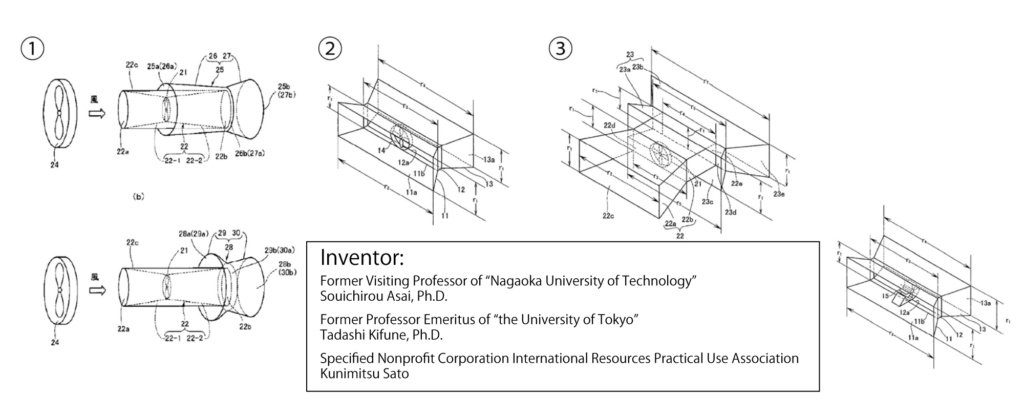
・JP 2011-140887: Application 2010.1.5 / Publication 2011.7.21 ① Double wind collector type wind turbine
・Patent No. 6033870: Application 2013.9.6 / Registration 2016.11.4 ② Flat Laval tube Patent
・Patent No. 6110455: Application 2015.10 .8/Registered 2017.3.17 ③ Double flat Laval tube
Basic Patent (Novelty, Originality)
Technological idea: The idea of this invention is to accelerate and increase the wind speed passing through the wind turbine by utilizing wind flow outside of the wind turbine.
Novelty: This wind turbine converts the low-speed flow at the back of the wind turbine into a high-speed flow that passes through the gap between the wind turbine and the wind collector wall, and discharges and diffuses it to the rear wind collector through friction and mixing. is dragged out by friction, mixing, and absorption by an external, faster, low-pressure wind flow outside the outlet .
Originality: This contact with the outside wind depends on the shape of the outlet. In other words, they discovered that expanding the outlet horizontally into a rectangle is much more effective than expanding it into a square or circular shape , and presented the rationale for this. In fact, expanding the outlet horizontally by three times resulted in a 45-fold increase in output .
The above explanation views the lateral expansion at the wind turbine location and the lateral expansion at the outlet from separate and independent perspectives.
As an added value, the cut-in speed of the wind turbine can be halved, making it possible to generate electricity from extremely light winds . Furthermore, since the wind turbine is installed inside a wind collector, it is safe and provides a sense of security.
Basic patent (Basic principle)
The contact interface between the outside wind and the inside wind is important, considering that the absorption of the inside wind flow by the outside wind flow and the drag due to frictional force due to the speed and pressure differences between the wind flows should be taken into consideration.
The concept of entropy, which is a major principle in nature, begins with the consideration and explanation of the isothermal reversible process in ideal gases of the Carnot cycle, but I believe that it can be fully understood only through molecular kinetic theory. Furthermore, the principle of fluid friction is based on the exchange of momentum at the contact surface between wind streams, and the formula for friction is derived based on the momentum transfer due to the movement of molecules per unit area.
Molecular kinetic theory considers the nuclear force and other energies inside molecules to be unchanging, considers molecules as balls with mass, and considers changes in their motion, momentum, and kinetic energy, and fluids are considered as aggregates of these. This simplifies the fluid model. In this case, changes in momentum and kinetic energy of the wind turbine’s wind flow will also be considered, and ultimately consideration of the contact interface between the wind flows will become important.
It has been verified that it is more advantageous to expand the outlet horizontally into a rectangle than to expand it into a square.
If a square discharge outlet with a side of 1 m is made into a square with a side of 2 m, the area will be 4 m2 and the circumference will be 8 m. If this 4 m2 area is expanded horizontally into a rectangle, the circumference will be is 10m, which increases the contact area and the ejection force. If it is further expanded to a square with sides of 3 m, the area becomes 9 m2 and the circumference is 12 m. If this is expanded horizontally, the circumference becomes 20 m, which further increases the discharge power. Furthermore, in this square enlargement of 3 m on a side, the distance the molecules move from the center to the periphery is more than 1.5 m, and in the horizontal expansion, the maximum distance the molecules move towards the periphery is always only 0.5 m, so our wind turbine represents an increase in ability of more than 10 times.
Numerical analysis example flow velocity
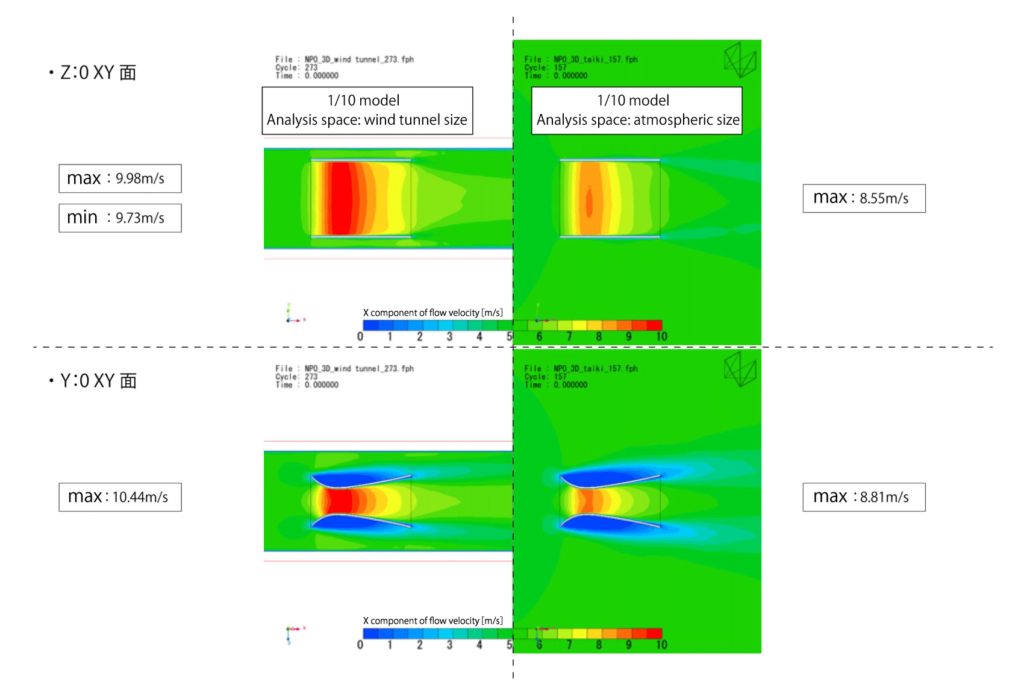
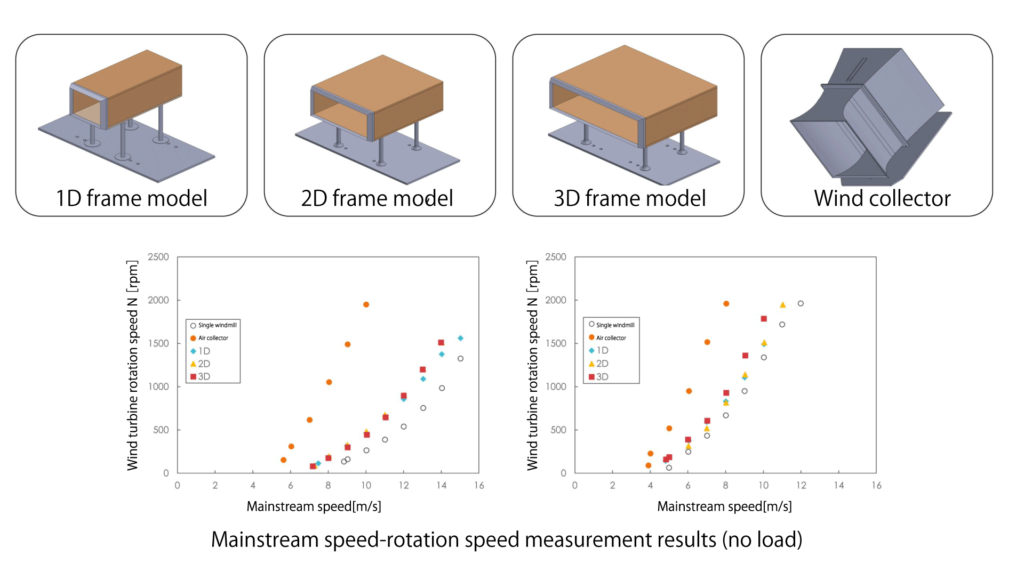
Small wind tunnel experiment examples
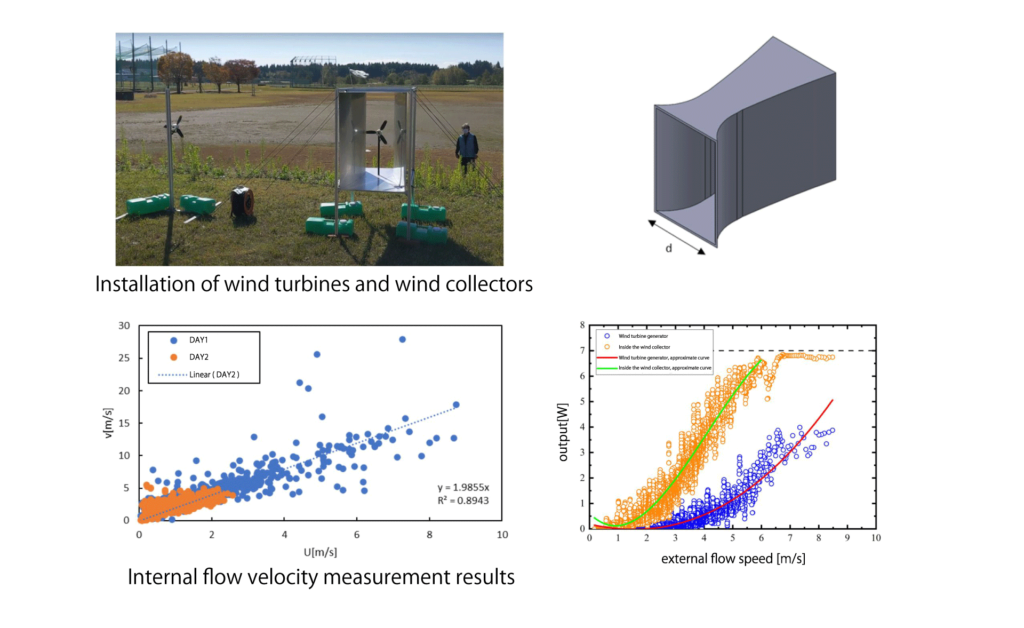
Field Experiment example
Comparison of rotation speed *1/8x speed


A small wind turbine equipped with a speed increaser installed on the roof of Nakahara Ward Office in Kawasaki City.
Usage example